Beyond the Phenotype: The Franceschi Frenchies® Roadmap to a CDDY-Clear French Bulldog Breeding Program by 2030
Updated: Aug 19
We spent more than a decade developing the phenotype. Now we are beginning the next chapter: deliberately aligning that phenotype with the genotype.
At Franceschi Frenchies®, responsible breeding has never meant chasing a single trait, title, color, pedigree—or genetic test.
It means generations.
For more than a decade, we have selectively developed our French Bulldogs around the qualities that define our program: genetic health, sound temperament, functional structure, movement, airway quality and unmistakable breed type.
Today, we are taking that work another step forward.
Our goal is to develop a CDDY-clear Franceschi Frenchies® breeding program by 2030.
And one of the most important parts of this story is where that journey begins.
We did not purchase a CDDY-clear French Bulldog and build a breeding program around a laboratory result.
The genetic foundation that makes our 2030 objective possible was produced here, within our own Franceschi bloodlines.
After more than a decade of selecting for the phenotype we wanted, expanded genetic testing revealed something significant: the normal CDDY allele was already present in multiple dogs we had produced.
Now our challenge is to preserve and expand that allele while protecting everything generations of selective breeding have established.
We are not replacing the Franceschi phenotype to obtain a genotype.
We intend to bring the two together.
What Is CDDY?
CDDY stands for chondrodystrophy.
The genetic test discussed here identifies an FGF4 retrogene insertion on canine chromosome 12, commonly referred to as 12-FGF4RG or the CDDY variant.
The variant is associated with premature degeneration of the intervertebral discs and increased susceptibility to intervertebral disc herniation.
A dog’s DNA test can return one of three results:
N/N — Zero copies of the CDDY variant
N/CDDY — One copy of the CDDY variant
CDDY/CDDY — Two copies of the CDDY variant
The inheritance is straightforward.
An N/N dog can transmit only N at this locus.
An N/CDDY dog can transmit either N or CDDY.
A CDDY/CDDY dog can transmit only CDDY.
That makes DNA testing an extraordinarily useful tool for selective breeding.
But there is an equally important distinction:
CDDY-clear does not mean IVDD-proof.
CDDY is an important genetic risk factor associated with intervertebral disc degeneration and
herniation. It is not the only factor affecting spinal health, nor does an N/N result guarantee that a dog can never experience a spinal problem.
That is why our program will never define a healthy French Bulldog by one DNA result.
CDDY is one piece of a much larger health picture.
How Common Is CDDY in the French Bulldog?
Very.
The available scientific evidence consistently shows that CDDY is extraordinarily prevalent within the French Bulldog population.
An earlier UC Davis Veterinary Genetics Laboratory dataset of 106 French Bulldogs reported a CDDY allele frequency of approximately 97%. As testing populations have expanded, UC Davis has continued to report a very high frequency of the variant within the breed.
More recently, a 2025 French Bulldog-specific study published in BMC Veterinary Research evaluated 81 French Bulldogs and reported a CDDY allele frequency of 85%.
Within that particular research population:
60 of 81 dogs (74%) carried two copies.
17 of 81 dogs (21%) carried one copy.
4 of 81 dogs (5%) carried zero copies.
That 5% figure should not be interpreted as meaning exactly 5% of all French Bulldogs worldwide are CDDY-clear. The dogs in that study were selected according to specific research criteria and do not constitute a worldwide random sample.
There is currently no comprehensive worldwide census establishing the exact percentage of N/N French Bulldogs.
What the available evidence does establish is clear:
The CDDY allele is extremely common in French Bulldogs, while dogs carrying zero copies exist but appear to be comparatively uncommon.
The same 2025 research also found that increasing numbers of CDDY copies were significantly associated with increasing numbers of radiographically calcified intervertebral discs.
For us, that provides another compelling reason to use the genetic information now available to breeders.
The Franceschi Difference: The Genetics Were Already Here
This is where our story becomes personal.
As we expanded genetic testing within our own dogs and productions, we began identifying N/CDDY French Bulldogs carrying one normal copy of the CDDY locus.
Among them is our stud:
Franceschi Frenchies Jimmy — N/CDDY.
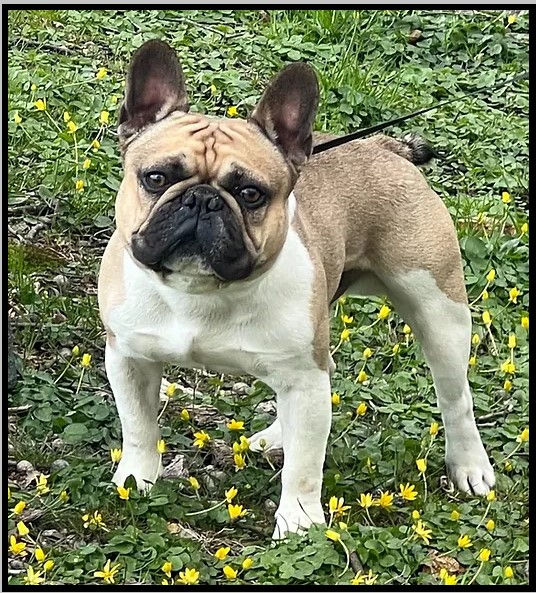
Jimmy was produced here.
His littermate sister, Franceschi Frenchies Panda, was also produced here.
Panda is N/CDDY.
Panda subsequently produced Pippi, another N/CDDY French Bulldog.
And Jimmy gave us another remarkable piece of information before we even tested him directly.
We tested all six puppies from one of his previous litters.
Three daughters tested N/CDDY.
Three sons tested CDDY/CDDY.
Because their dam was CDDY/CDDY and therefore could contribute only CDDY at this locus, the N allele found in those daughters had to have come from Jimmy.
When Jimmy was subsequently tested himself, the result confirmed what his offspring had already told us:
N/CDDY.
That discovery changed how we began thinking about the future of our program.
The genetics necessary to begin moving away from CDDY weren't something we needed to go purchase.
We had already produced them.
First Came the Phenotype
This distinction is extremely important to us.
We didn't breed those dogs because they carried N.
At the time, CDDY was not driving those breeding decisions.
We selected the pairings because of the qualities we had spent years developing: structure, temperament, breed type, pedigree, health and the consistency we were seeing in our productions.
Only afterward did expanded DNA testing reveal that some of those same dogs carried the normal N allele.
The dogs met our standard before the genetic result became part of the equation.
That is exactly how we want this project to continue.
We will not retain a mediocre dog simply because it tests N/N.
And we will not abandon an exceptional family simply because it has not reached N/N yet.
Our objective is to ultimately produce French Bulldogs that would meet the Franceschi standard regardless of what their CDDY test said—and then have that test say N/N.
That is a considerably more difficult breeding objective.
We believe it is also the right one.
Fall 2026: The Next Generation Begins
Our Fall 2026 breeding program represents an important transition point.
Multiple planned pairings involve an N/CDDY parent, giving us opportunities to move the normal N allele into several branches of our breeding population.
One particular planned pairing has N/CDDY on both sides.
That mating creates the following probability for each puppy:
N/CDDY × N/CDDY
25% N/N
50% N/CDDY
25% CDDY/CDDY
These are probabilities for each individual puppy—not guaranteed litter percentages.
But for the first time within this next phase of our program, it creates the opportunity to produce an N/N French Bulldog entirely from genetics developed within Franceschi Frenchies®.
If we produce that puppy, it will be an important milestone.
It will not mean the project is finished.
It means the next stage can begin.
The Dog We Are Looking For
Our objective is not simply to produce an N/N puppy.
We are looking for a dog that represents everything our program has spent generations trying to produce:
Structure.
Temperament.
Movement.
Airway quality.
Health.
Balance.
Breed type.
Pedigree.
And then:
CDDY N/N.
That distinction is essential.
If an N/N puppy does not meet our standards for the whole dog, the DNA result alone will not earn that puppy a position in our breeding program.
The genotype must complement the phenotype—not replace it.
How One N/N Dog Can Begin Changing a Population
An appropriately selected N/N breeding dog creates tremendous genetic opportunity.
Consider an N/N dog paired with an outstanding CDDY/CDDY dog whose genetics we want to preserve:
N/N × CDDY/CDDY
Every puppy receives N from the N/N parent and CDDY from the CDDY/CDDY parent.
The expected result is:
100% N/CDDY.
That means an exceptional CDDY/CDDY family does not have to be thrown away simply because of one genetic locus.
Instead, we can preserve what is valuable about that family while moving every offspring one generation closer to clear.
The next step becomes:
N/N × N/CDDY
Approximately:
50% N/N
50% N/CDDY
0% CDDY/CDDY
And ultimately:
N/N × N/N
For this tested locus:
100% N/N offspring.
That is how a single result becomes a multigenerational breeding strategy.
Why 2030? Why Not Eliminate CDDY Immediately?
Because genetic improvement requires more than eliminating one allele.
When a genetic variant occurs at very high frequency within a breed, immediately eliminating every dog carrying that variant can dramatically reduce the available breeding population.
That can reduce genetic diversity and potentially concentrate other undesirable traits.
We refuse to exchange one genetic problem for another.
Our approach will therefore be deliberate.
We intend to use valuable N/CDDY dogs strategically.
We may continue using exceptional CDDY/CDDY dogs when they contribute qualities important to the program, pairing them appropriately to move their descendants toward N.
And as N/N dogs become available, we intend to establish the genotype across multiple branches, rather than building the future of the program around one genetically narrow family.
Our goal isn't to get to N/N fastest.
Our goal is to get there correctly
That is why we chose 2030.
Protecting Genetic Diversity
Franceschi Frenchies® already has an important advantage in this transition.
Our breeding population isn't genetically identical.
Some dogs represent concentrated Franceschi families developed over generations.
Others represent partial outcrosses.
Others are complete outcrosses to our established blood.
That gives us multiple pathways through which the normal N allele can potentially move.
Our long-term objective isn't one N/N stud breeding everything.
It is to develop:
Multiple N/N males.
Multiple N/N females.
Multiple family branches.
Multiple breeding choices.
And ultimately, appropriate N/N × N/N combinations that preserve both genetic diversity and the characteristics that define our dogs.
CDDY-clear without a healthy gene pool would not represent success.
Are Other French Bulldog Programs Doing This?
Yes.
And we believe they deserve recognition.
Our research has identified French Bulldog breeders outside the United States—including programs in Australia—who have publicly discussed CDDY testing, reduction or elimination as part of their breeding strategies.
Programs including Chaleureux French Bulldogs, Majorbulls French Bulldogs, Mightyburns Bulls and Bibbyboo French Bulldogs have publicly discussed CDDY within the context of genetic testing or breeding decisions.
Publicly available breeder materials also demonstrate that CDDY-clear French Bulldogs and pairings intended to reduce the CDDY variant exist outside our program.
That matters because Franceschi Frenchies® is not claiming to have discovered CDDY-clear breeding.
Nor are we claiming to be the first people in the world attempting it.
We are joining a small but important conversation already occurring within the breed.
And we hope that conversation grows.
Are We the First in the United States?
We cannot responsibly make that claim.
There is no authoritative national or international registry identifying every French Bulldog breeder according to CDDY status.
There is no reliable database telling us exactly how many U.S. breeders have produced an N/N French Bulldog.
And there is no worldwide census identifying every program actively attempting to become CDDY-clear.
Internet research can identify what breeders have made public.
It cannot prove what no breeder has ever done privately.
Therefore:
Franceschi Frenchies® will not claim to be first, only, or one of an exact number unless verifiable evidence someday supports that statement.
If another breeder has already established a CDDY-clear French Bulldog program, we genuinely welcome that information.
Show us.
Share the testing.
Share the experience.
We would rather discover that ten responsible programs are doing this than pretend we are the only one.
Because improving the genetic future of the French Bulldog should never become a contest over who gets credit first.
Rare does not give us permission to exaggerate.
The truth is powerful enough.
What Will a CDDY-Clear French Bulldog Mean at Franceschi Frenchies®?
It will not mean that we claim to have eliminated IVDD.
It will not mean that an N/N puppy is guaranteed never to experience a spinal problem.
And it will not mean that one DNA result replaces comprehensive health evaluation.
Our 2030 objective is very specific:
Remove the tested chromosome-12 CDDY variant from our active breeding population through deliberate genetic selection.
We intend to continue evaluating the whole dog.
That includes genetic health testing, structural evaluation, orthopedic health, spinal considerations, airway quality, temperament, movement, reproductive fitness and overall breed type.
CDDY N/N will become another standard we expect our future breeding dogs to meet—not the only standard that matters.
What Success Looks Like in 2030
Success is not producing one N/N puppy.
It isn't owning one CDDY-clear stud.
And it isn't putting "CDDY CLEAR" on a website.
Our objective is program-level change.
By 2030, we intend to have developed appropriately selected N/N breeding dogs across our program so that CDDY-clear pairings can become increasingly standard.
Ultimately:
N/N × N/N = 100% N/N offspring for this tested CDDY variant.
But the genotype is only half of our definition of success.
We want to arrive there with:
The Franceschi phenotype intact.
Sound temperament intact.
Structure and movement intact.
Airway quality protected.
Genetic diversity protected.
Multiple family branches represented.
Health testing expanded—not reduced.
And a documented trail showing exactly how we got there.
We Will Document the Journey
Beginning with our Fall 2026 breeding program, we intend to document this project as it develops.
We will track genetic results.
We will study pedigrees.
We will identify where the N allele exists within our families.
We will evaluate offspring as they mature.
We will continue orthopedic, structural and genetic health testing.
And we will make breeding decisions based upon the complete dog.
Genetics will not always give us exactly what we want.
A mating capable of producing N/N may produce none.
An N/N puppy may not develop into the dog we want representing Franceschi.
An exceptional N/CDDY puppy may occasionally be more valuable to the long-term transition than an average N/N puppy.
If that happens, we will choose the long-term health of the program over the fastest route to a headline.
That is breeding.
And that is why this journey will take generations.
Built Here. Improved Here.
Perhaps the part of this project that means the most to us is knowing where it started.
The N allele was already here.
It existed within dogs carrying genetics we had spent years developing.
It appeared in siblings.
It was passed to daughters.
And it was discovered within generations produced before "CDDY-clear by 2030" was ever written as an objective.
We didn't purchase a genetic result and build a story around it.
We produced the genetics.
We recognized their significance.
Now we intend to use them responsibly.
The Next Chapter
Responsible breeding doesn't have a finish line.
Science advances.
Testing improves.
Dogs teach us.
And generations reveal things one litter never can.
A breeder's responsibility is not to pretend yesterday's knowledge was complete.
It is to use better information when it becomes available and continue moving forward.
Our first decade established the foundation.
Now comes the next chapter.
Matching phenotype with genotype.
Preserving what generations built.
Improving what genetics now allows us to improve.
Working toward a CDDY-clear Franceschi Frenchies® breeding program by 2030.
Not through shortcuts.
Not by abandoning the dogs that built our program.
Not by sacrificing the French Bulldog phenotype we have spent generations developing.
But deliberately.
Transparently.
And generation by generation.
Franceschi Frenchies®
Built through generations. Improving with every one.

Comments